

Two Things Can Be True
Why We Struggle to See the Full Truth
Have you ever felt like you had to find the truth in a situation? Like there was one “right” answer, and everything else was, by default, “wrong”?
Take, for example, a conflict with your partner. You might feel the searing pain of hurt (or anger or betrayal) and know you are right to feel hurt… But does that inherently make your partner wrong?
What if the truth isn’t either/or?
Here me out. What if your hurt is valid and your partner’s actions make sense given their unique experience and perspective?
What if no one is the bad guy?!
The ability to hold two truths at once is a foundation for both emotional and social intelligence.
The Opposite of Two Things Can Be True: Black-and-White Thinking
The tendency to see things in rigid, polarized categories is called black-and-white thinking (also known as all-or-nothing thinking—same idea).
It’s the belief that things must be either/or, right or wrong, all good or all bad. And while putting things into neat little boxes might feel easier in the moment, it also deprives us of seeing the whole picture.
In reality, two things can be true at the same time.
And learning to hold that duality, without collapsing into extremes, is where growth happens.

What Does “Two Things Can Be True” Really Mean?
Letting go of black-and-white thinking means stepping into emotional nuance.
It means recognizing that just because something is difficult, it doesn’t mean you can’t do it.
That just because someone hurt you doesn’t mean they’re a bad person.
That two seemingly opposite experiences can exist side by side… and both be valid.
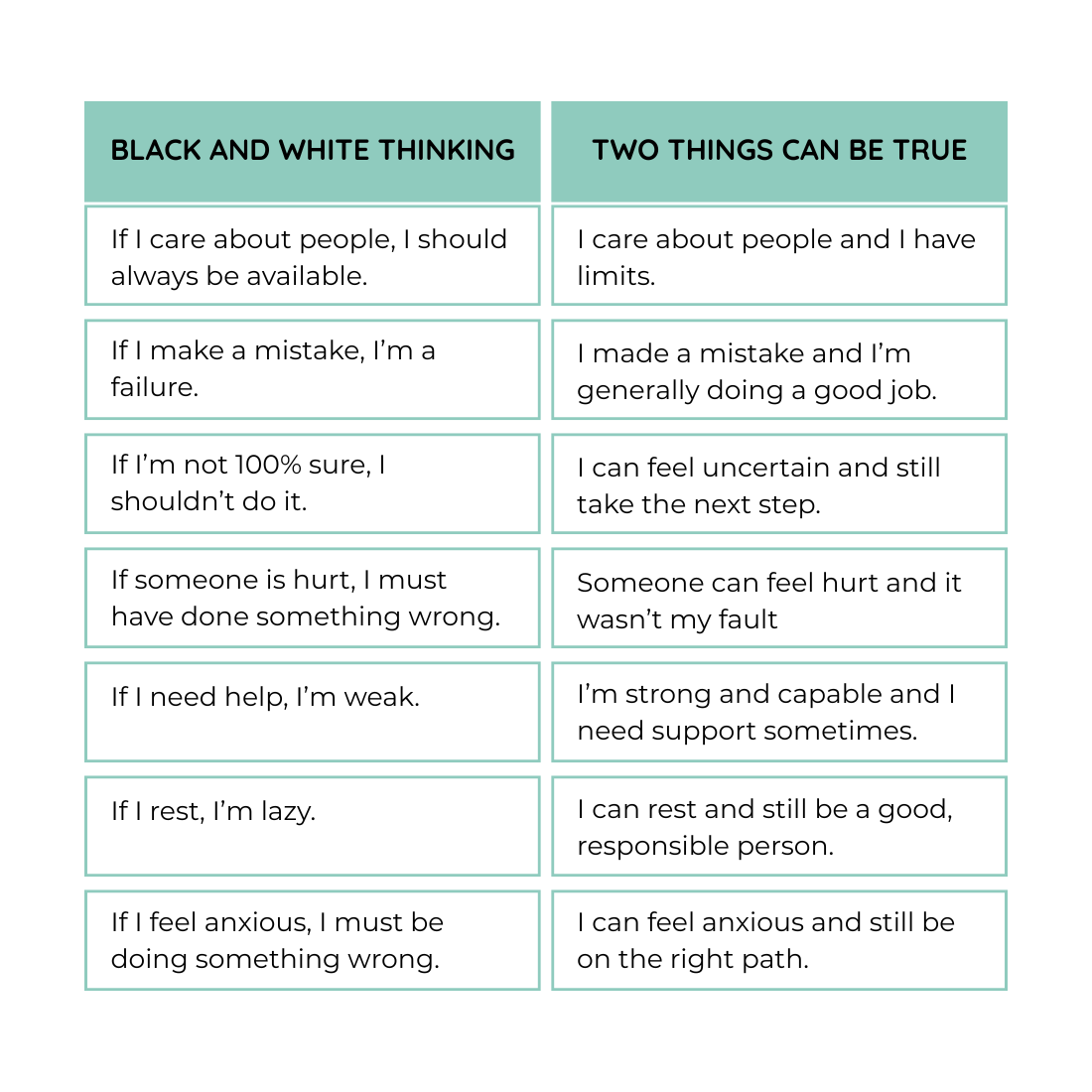
Two Things Can Be True: Real-Life Examples
Let’s take a look at some everyday examples where black-and-white thinking shows up and consider how we can reframe them with more emotional honesty:
Why Black and White Thinking Feels Safer (But Isn’t)
Binary thinking often shows up when our nervous system is feeling threatened. In these moments, black-and-white thinking can feel protective, like a shortcut through emotional overwhelm. It gives us the illusion of clarity, control, and certainty.
If I can just figure out the one right answer, I’ll be ok.
But over time, this kind of rigid thinking can quietly start to do harm.
It limits your emotional range. It tells you there’s only one acceptable way to feel, which often leads to shame or self-rejection when you feel anything other than what you’re “supposed to.”
It can also reinforce impossible standards: “If I’m not completely calm, then I’m falling apart.” or “If I’m not giving 100%, I’m not doing enough.” This creates burnout, perfectionism, and a chronic sense of never being enough.
And the impact doesn’t stop with you.

Learning to step out of black and white thinking isn’t just about emotional flexibility.
It’s about making space for complexity, for grace, and for the deeper truths that only emerge when we stop trying to flatten everything into either/or.
How to Start Practicing “Two Things Can Be True”
If you want to start making more room for multiple truths, remember that changing our thought patterns takes time and repetition. Start by bringing this phrase in your day-to-day life: Two things can be true. Say it when you feel conflicted. Say it when you’re trying to explain something complex, especially to yourself. Say it when your inner critic tells you that something has to be one way or the other. The more you practice it, the more your nervous system will learn that safety can exist in nuance.
Final Thought: You Don’t Have to Pick a Side
If you take away one thing from this post, let it be that multiple truths can coexist at the same time.
You don’t have to fall prey to the good or bad, right or wrong fallacy.
Instead, let’s get comfortable in the in-between. There’s a lot of life lived in the grey.
Ready to Go Deeper?
If black and white thinking feels familiar, and you often find yourself stuck in looping thoughts, pressure to get it right, or anxiety that won’t let up… there might be a bigger reason. This kind of mental pattern is a hallmark of what I call The Anxiety Loop – a cycle that keeps your brain spinning in overdrive, even when you know better. 👉 Explore The Anxiety Loop Course Inside, I’ll guide you through all the related pieces of this pattern and teach you how to interrupt the cycle with tools that are simple, clear, and trauma-informed. Let’s break the loop together.